

Oscilloscopes for Signal Analysis, Debugging & Electronic Test
Oscilloscopes are among the most important instruments in electronics engineering, semiconductor test, telecommunications, aerospace, automotive, power electronics, manufacturing, and research laboratories. These systems visualize voltage signals over time, allowing engineers to evaluate waveform shape, timing, noise, frequency, rise time, transients, modulation, and other electrical behavior that cannot be understood from a simple multimeter reading. From debugging a circuit board to validating a high-speed digital interface, a properly selected oscilloscope can dramatically improve troubleshooting and test efficiency.
Organizations comparing digital oscilloscopes, digital phosphor oscilloscopes, mixed-signal oscilloscopes, high-bandwidth oscilloscopes, and used electronic test equipment should look beyond channel count alone. Bandwidth, sample rate, memory depth, trigger capability, probe compatibility, interface support, software options, and condition all affect how useful a scope will be in practice. A 100 MHz bench oscilloscope and a 1 GHz high-speed instrument may look similar, but they support very different measurement environments.
What Is an Oscilloscope?
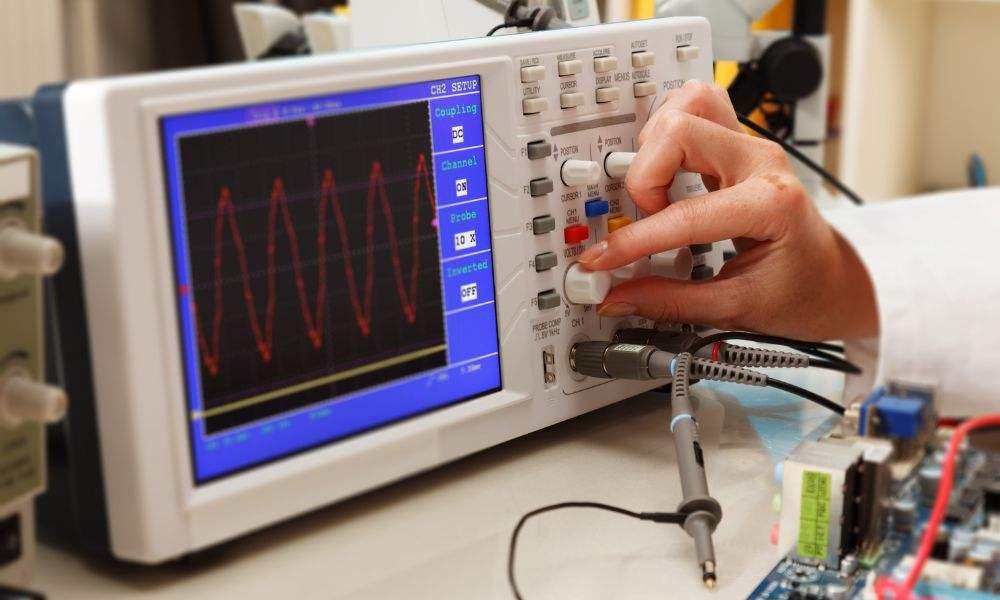
An oscilloscope is an electronic test instrument that displays electrical signals as waveforms, usually plotting voltage on the vertical axis against time on the horizontal axis. This allows users to observe how a signal changes and identify problems such as distortion, ringing, overshoot, timing errors, noise, signal dropouts, and unexpected transients.
Modern digital oscilloscopes capture and store waveform data so it can be measured, analyzed, saved, and compared. Most current systems include automatic measurements, cursors, FFT analysis, advanced triggering, waveform math, and digital storage. Higher-end platforms may also support protocol decoding, eye diagrams, jitter analysis, serial bus analysis, power measurements, and automated compliance testing.
Why Bandwidth Matters
Oscilloscope bandwidth determines the highest-frequency signal content the instrument can measure accurately. A scope with insufficient bandwidth can attenuate fast edges and distort waveform shape, making a signal appear cleaner or slower than it actually is. This is especially important when testing digital electronics, RF-related signals, high-speed communications, and modern power electronics.
Bandwidth should be selected based on signal rise time and frequency content, not only the nominal clock frequency. Engineers often require considerably more bandwidth than the fundamental signal frequency to preserve harmonics and capture realistic edge behavior. Purchasing too little bandwidth can limit future use, while purchasing far more than needed may add unnecessary cost.
Sample Rate and Memory Depth
The sample rate tells you how many measurements the oscilloscope can capture each second. Higher sample rates provide more data points across fast transitions and short-duration events, helping reproduce the waveform more accurately. For high-speed digital debugging and transient analysis, sample rate can be just as important as analog bandwidth.
Memory depth, or record length, determines how much waveform data the instrument can store during an acquisition. Deeper memory allows users to capture longer periods of time while maintaining a high sample rate, which is useful when troubleshooting intermittent errors or analyzing complex digital sequences. A scope with strong bandwidth but limited memory may still be restrictive for long captures or protocol debugging.
Digital Storage vs. Digital Phosphor Oscilloscopes
A digital storage oscilloscope (DSO) captures waveforms digitally and stores them for display and analysis. These instruments are widely used for general electronics troubleshooting, waveform measurement, and engineering applications. They offer stable triggering, automatic measurements, and the ability to save or export waveform data.
A digital phosphor oscilloscope (DPO) adds enhanced waveform intensity information, making frequently occurring waveform activity appear differently from less common events. This can make intermittent glitches, signal variations, and timing anomalies easier to identify. Tektronix is particularly well known for the DPO architecture, which became popular in high-speed debugging and advanced electronic test.
Mixed-Signal and Protocol Analysis
A mixed-signal oscilloscope combines analog oscilloscope channels with digital logic channels, allowing engineers to view analog behavior and digital logic activity at the same time. This is especially useful when troubleshooting embedded systems, microcontrollers, FPGA designs, serial buses, and mixed analog-digital electronics.
Many modern oscilloscopes also support serial protocol decoding for interfaces such as I²C, SPI, UART, CAN, LIN, USB, Ethernet, and other communication standards depending on installed options. Protocol analysis can save significant troubleshooting time because the instrument translates electrical activity into readable packets or bus events. When buying used equipment, option licenses should be checked carefully because advanced decoding and analysis features may depend on installed software keys.
Common Oscilloscope Applications
Oscilloscopes are used across a wide range of engineering, laboratory, and manufacturing environments.
Common applications include:
-
Circuit board troublesh
-
ooting
-
Signal integrity analysis
-
Power electronics testing
-
Semiconductor device evaluation
-
Embedded system debugging
-
Serial bus analysis
-
Telecommunications testing
-
Automotive electronics
-
Aerospace and defense electronics
-
RF and high-speed digital development
-
Education and research
-
Production test and quality control
In R&D, oscilloscopes help engineers visualize and characterize new designs during development. In manufacturing, they can support troubleshooting, validation, and failure analysis. Service organizations also rely on oscilloscopes to identify faults quickly in electronic assemblies and systems.
What to Consider When Purchasing an Oscilloscope
When purchasing a used oscilloscope, the most important specifications should be matched to the signals you expect to measure. Bandwidth and sample rate usually receive the most attention, but memory, trigger capability, probes, channel count, software, and installed options can have an equally large effect on usability.
Important considerations include:
-
Analog bandwidth
-
Sample rate
-
Number of channels
-
Memory depth
-
Trigger capability
-
Probe compatibility
-
Input impedance
-
Display condition
-
Serial protocol decoding
-
FFT and advanced math functions
-
Installed software options
-
Communication interfaces
-
Calibration status
-
Overall instrument condition
Probe condition deserves special attention. High-bandwidth passive probes, active probes, current probes, differential probes, and specialized adapters can be expensive, so a used oscilloscope that includes the correct accessories may offer significantly better value than a lower-priced bare unit.
Recommended Oscilloscopes

Tektronix DPO5104B 4-Channel Oscilloscope – A high-performance digital phosphor oscilloscope designed for advanced signal analysis, debugging, and high-speed electronics testing. With 1 GHz bandwidth, 10 GS/s sampling, and four analog channels, the DPO5104B is well suited for signal integrity work, embedded systems, communications, and engineering labs that need strong waveform capture and analysis capability.
Tektronix TDS5104B Digital Phosphor Oscilloscope – A recognized Tektronix high-bandwidth DPO platform used in electronics design, semiconductor test, communications, and research. The TDS5000B family is known for deep analysis capability and advanced triggering, making it useful for complex waveform troubleshooting and high-speed signal work.
HP 54845A Infinium Oscilloscope – A classic high-performance Infiniium platform from Hewlett-Packard, later Agilent, designed for advanced digital and analog signal analysis. These systems remain popular in used test-equipment markets because of their robust construction, deep feature set, and suitability for engineering labs working with complex electronic signals.

Tektronix MSO58 Mixed Signal Oscilloscope – A modern mixed-signal platform widely used for embedded design, high-speed digital debugging, and power analysis. The MSO5 Series combines strong analog performance with extensive digital and software-based analysis tools.
Keysight InfiniiVision 6000 X-Series – A well-known family of digital and mixed-signal oscilloscopes used for general engineering, embedded systems, serial bus debugging, and production test. These systems are popular for their responsive interface and broad range of analysis options.
Rohde & Schwarz RTO Series Oscilloscopes – High-performance oscilloscopes used for signal integrity, communications, automotive, power, and advanced electronics development. They are recognized for strong acquisition performance and detailed signal analysis.
Why Used Oscilloscopes Can Offer Strong Value
New high-bandwidth oscilloscopes can be expensive, especially once deeper memory, protocol decoding, advanced triggers, software options, and premium probes are added. A tested used oscilloscope can provide access to professional-grade bandwidth and analysis features at a much lower acquisition cost, making it attractive for engineering labs, universities, electronics manufacturers, repair facilities, and startups.
Used scopes can also be especially valuable when a lab already uses a familiar platform. Keeping the same instrument family can preserve operator training, probe compatibility, measurement workflows, and software procedures. In many cases, a well-maintained older Tektronix, HP, Agilent, Keysight, LeCroy, or Rohde & Schwarz oscilloscope can still provide excellent practical performance for routine development and troubleshooting.
Choosing the Right Oscilloscope
The best oscilloscope for electronics testing depends on the signal bandwidth, required sample rate, number of channels, capture length, and analysis features needed for the application. A general electronics lab may be well served by a 100–500 MHz scope, while high-speed digital, RF-adjacent, semiconductor, and communications work may require 1 GHz or more.
It is also important to account for the total test setup rather than only the main instrument. Probes, adapters, software options, licenses, and calibration can meaningfully affect both performance and cost. By comparing bandwidth, sampling, memory, trigger capability, installed options, and overall condition, labs can select a used oscilloscope that delivers the performance they need without overspending on unnecessary capability.
Looking for Oscilloscopes & Electronic Test Equipment?
Explore ProTech Supply’s inventory of used Tektronix oscilloscopes, HP and Keysight test equipment, digital phosphor oscilloscopes, mixed-signal instruments, and electronic test systems, or consign surplus equipment to connect with qualified buyers.