

Industrial Conveyor Systems for Automated Material Handling & Production Lines
Industrial conveyor systems are a core part of modern manufacturing, assembly, packaging, inspection, warehousing, and factory automation. These systems move parts, components, containers, pallets, and finished products between production stages while helping manufacturers reduce manual handling and maintain consistent workflow. Depending on the application, facilities may use belt conveyors, roller conveyors, modular conveyors, dual-belt conveyors, pallet transfer systems, timing-belt conveyors, or automated accumulation conveyors.
Organizations comparing industrial conveyors, automated conveyor systems, factory automation conveyors, material handling equipment, and used conveyor systems should consider product size, load weight, conveyor speed, positioning accuracy, belt material, frame construction, sensors, stops, controls, and integration requirements. A simple belt conveyor may be enough for basic product transport, while an automated assembly line may require pneumatic stops, sensors, indexing, robotic interfaces, and precise workpiece positioning. Selecting the right conveyor can improve throughput while reducing unnecessary handling between production processes.
What Is an Industrial Conveyor System?
An industrial conveyor system is a mechanical material-handling platform designed to move products or components along a defined path. The basic system may consist of a motor, drive, frame, belt or rollers, and support structure, while more advanced conveyors incorporate sensors, pneumatic actuators, stops, lifts, transfers, and programmable automation controls.
Conveyors can operate as standalone material-transfer systems or as integrated components within much larger production equipment. In automated factories, they frequently connect assembly stations, robotic cells, machine vision systems, test equipment, packaging machinery, and inspection processes. This makes compatibility with surrounding automation just as important as the conveyor's mechanical specifications.
Belt Conveyor Systems
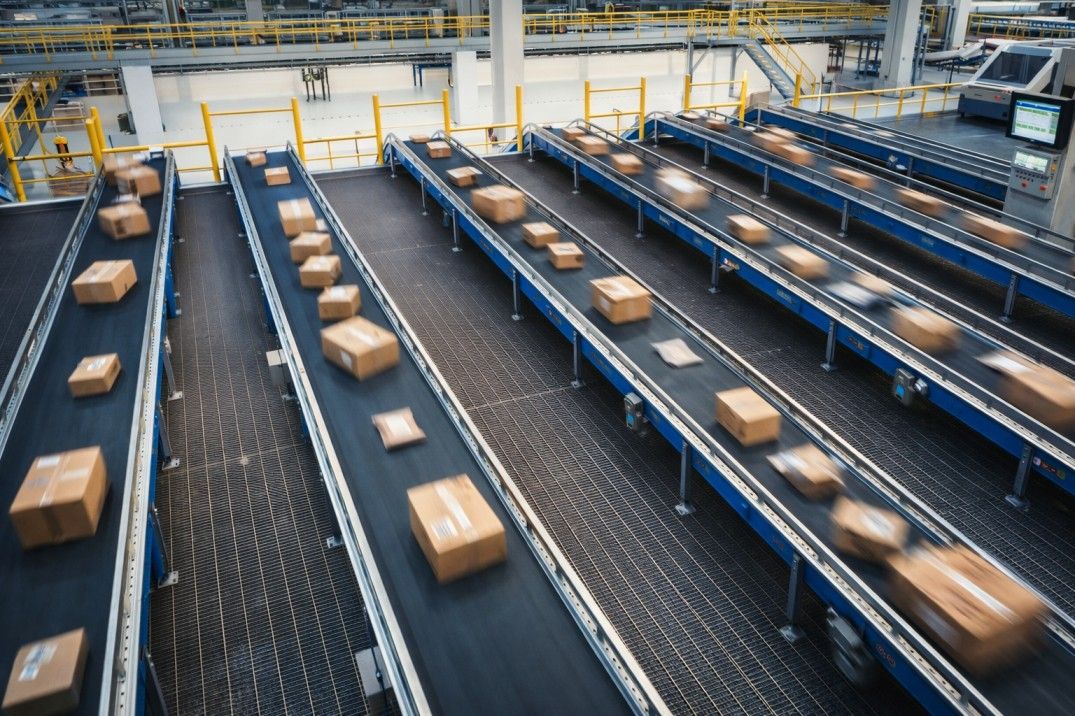
Belt conveyors are among the most widely used conveyor types because they can transport an enormous variety of products. A continuous belt moves over rollers or a supporting surface, allowing boxes, components, containers, molded parts, electronics, and other materials to travel smoothly between production stages. Belt material can be selected for properties such as grip, chemical resistance, cleanliness, static control, or heat resistance.
Compact belt conveyors are especially common in electronics, medical device, pharmaceutical packaging, and automated assembly applications. Larger industrial versions can handle heavier products and longer transport distances. When sourcing a belt conveyor, buyers should consider usable belt width, overall length, load capacity, speed, motor configuration, and whether the conveyor needs to stop or accurately position individual products.
Double-Belt & Timing-Belt Conveyors
Double-belt conveyors use two parallel belts rather than one continuous surface. This configuration can support a product, fixture, or pallet along two edges while leaving the center open for inspection, processing, lifting, or access from below. Dual-belt designs are particularly useful in automated assembly lines where parts need to be transported while remaining accessible to other machinery.
Timing-belt and precision dual-belt conveyors can also provide more controlled product movement than basic transport belts. They may be combined with pneumatic stops, sensors, indexing systems, and workpiece carriers to accurately position products at individual processing stations. This makes them particularly relevant for robotic assembly, electronics production, testing, machine vision inspection, and other automated manufacturing environments.
Roller Conveyor Systems

Roller conveyors use a series of rollers to move boxes, totes, pallets, and other relatively rigid products. Gravity roller conveyors rely on slope or manual force, while powered roller systems use motors to move products automatically. Powered systems may also support accumulation, zone control, and product spacing.
Roller conveyors are widely used in warehouses, shipping areas, packaging lines, distribution centers, and manufacturing plants. They are especially useful when products have flat, stable bottoms and need to move over longer distances. Buyers should evaluate roller spacing, product dimensions, load capacity, drive configuration, and whether accumulation or automated routing is required.
Pallet Transfer & Workpiece Conveyor Systems
Pallet conveyor systems move workpiece carriers or fixtures through manufacturing and assembly processes. Instead of transporting the product directly on the belt, the component is placed on a standardized pallet that can be repeatedly positioned at machining, testing, assembly, or inspection stations.
These systems are popular in automated manufacturing because the pallet establishes a repeatable reference point for robots, tooling, cameras, and sensors. Stops, lifts, transfers, turntables, and identification systems can be added to create complex production routes. Pallet-based conveyor systems are widely used in automotive, electronics, medical device, and precision manufacturing environments where consistent product positioning is essential.
Sensors, Pneumatic Stops & Conveyor Automation
Modern automated conveyor systems often include sensors that detect product presence, location, spacing, or movement. Photoelectric sensors, proximity sensors, encoders, and other devices can communicate with PLCs or machine controls to coordinate conveyor movement with upstream and downstream equipment.
Pneumatic stops allow individual products or carriers to be held at specific locations for assembly, inspection, testing, or robotic operations. Once the process is complete, the stop releases the product and allows it to continue down the line. This combination of conveyor motion, sensing, and controlled stopping turns a basic material-handling system into an important part of a fully automated production process.
Common Applications for Industrial Conveyors
Industrial material handling conveyors are used across virtually every manufacturing sector.
Common applications include:
-
Automated assembly lines
-
Electronics manufacturing
-
Automotive component production
-
Packaging and labeling
-
Machine vision inspection
-
Robotic pick-and-place systems
-
Pharmaceutical and medical device manufacturing
-
Product testing
-
Warehouse material handling
-
Food and beverage processing
-
Sorting and accumulation
-
Manufacturing work-cell integration
The best conveyor configuration depends heavily on the product being moved. Small electronic assemblies may require compact precision conveyors with sensors and antistatic belts, while warehouse operations may need powered roller systems capable of handling larger cartons or pallets. Defining the load and process requirements first helps prevent purchasing equipment that is either undersized or unnecessarily complex.
What to Consider When Purchasing an Industrial Conveyor
When purchasing a used industrial conveyor system, the conveyor's physical dimensions should be evaluated alongside its automation features. Belt width, overall length, working height, motor orientation, and frame configuration all determine whether the system can physically fit into an existing production line.
Important considerations include:
-
Conveyor type
-
Belt or roller width
-
Conveyor length and height
-
Load capacity
-
Conveyor speed
-
Motor and gearbox configuration
-
Belt material
-
Sensors and switches
-
Pneumatic stops or indexing
-
PLC and control compatibility
-
Workpiece or pallet dimensions
-
Electrical requirements
-
Frame and bearing condition
-
Included accessories and guarding
Integration can be more important than the purchase price. A conveyor that already includes suitable sensors, stops, brackets, controls, and mounting hardware may be considerably easier to install than a lower-cost bare conveyor. Used systems should also be inspected for belt wear, damaged rollers, bearing noise, motor condition, alignment, pneumatic leaks, and missing control components.
Recommended Industrial Conveyor Systems

mk DGF-P 2001 Double Belt Conveyor – A dual-belt industrial automation conveyor designed for controlled movement and positioning of parts or workpiece carriers. The inclusion of pneumatic stops and sensors makes this configuration particularly useful for automated assembly, inspection, machine vision, or production processes where products need to stop accurately at defined workstations.
Dorner 2200 Series Conveyors – One of the most recognizable compact conveyor families used in automation, packaging, electronics, medical device, and light industrial manufacturing. The 2200 Series is available in numerous belt, modular belt, and precision configurations and is widely integrated with sensors, robots, and automated machinery.
mk GUF-P 2000 Belt Conveyor – A well-known modular belt conveyor platform used for industrial material handling and factory automation. Its aluminum-profile construction and flexible configuration make it popular for assembly lines, machine integration, and component transport.
Bosch Rexroth TS 2plus Transfer System – A widely recognized pallet-transfer conveyor system designed for automated assembly and manufacturing. It is commonly used where workpiece pallets must move between production, testing, inspection, and robotic stations with repeatable positioning.
FlexLink X85 Conveyor System – A modular conveyor platform commonly used in automated production and packaging environments. FlexLink systems can be configured with curves, transfers, guides, accumulation, and automation components to support complex production layouts.
Interroll Modular Conveyor Platform – A popular powered roller and material-handling conveyor family used in manufacturing, logistics, packaging, and distribution environments. Interroll systems are particularly well known for modular roller conveyor and accumulation applications.
Why Used Conveyor Systems Can Offer Strong Value
New industrial automation conveyor systems can become expensive when custom frames, motors, sensors, stops, PLC controls, guarding, and installation hardware are added. Purchasing a used conveyor can significantly reduce capital cost, particularly when the system already includes useful automation hardware that would otherwise need to be engineered and installed separately.
Used conveyors can be especially valuable when manufacturers are expanding an existing production line or replacing equipment from the same platform family. Existing belt sizes, frame profiles, motors, workpiece pallets, sensors, and control architecture may remain compatible, reducing installation time. A complete used system can therefore provide greater practical value than a newer conveyor requiring substantial customization before it can enter production.
Choosing the Right Conveyor for Your Production Line
The right industrial conveyor system depends on product dimensions, weight, required positioning accuracy, throughput, and the processes performed along the line. Basic transportation may only require a belt or roller conveyor, while automated assembly may benefit from a dual-belt or pallet-transfer platform equipped with sensors, stops, and indexing hardware.
Manufacturers should also think beyond current production requirements. A modular conveyor that can accept future sensors, additional sections, robotic interfaces, or workstations may provide greater long-term value than a fixed transport system. By comparing conveyor design, automation capability, dimensions, controls, and overall condition, facilities can select used industrial conveyor equipment that improves material flow without requiring unnecessary redesign.
Looking for Industrial Conveyors & Factory Automation Equipment?
Explore our inventory of used industrial conveyor systems, automation conveyors, material handling equipment, sensors, and manufacturing machinery, or consign surplus equipment to connect with qualified industrial buyers.
Visit us at ProTechSupply.com
📦 Worldwideshipping available